News from
Roquia Salam (University College London, UK)
A new paper entitled “Review article: rainfall-induced landslide early warning systems through the lens of the early warnings for all framework – advances, gaps, and perspectives” by Roquia Salam, Bayes Ahmed, and Peter Sammonds has just been published in Natural Hazards and Earth System Sciences: https://doi.org/10.5194/nhess-26-5469-2026
The review assesses rainfall-induced landslide early warning systems (LEWS) against the four pillars of the UN Early Warnings for All (EW4All) framework:
- Risk knowledge
- Monitoring and forecasting
- Warning dissemination and communication
- Preparedness and response
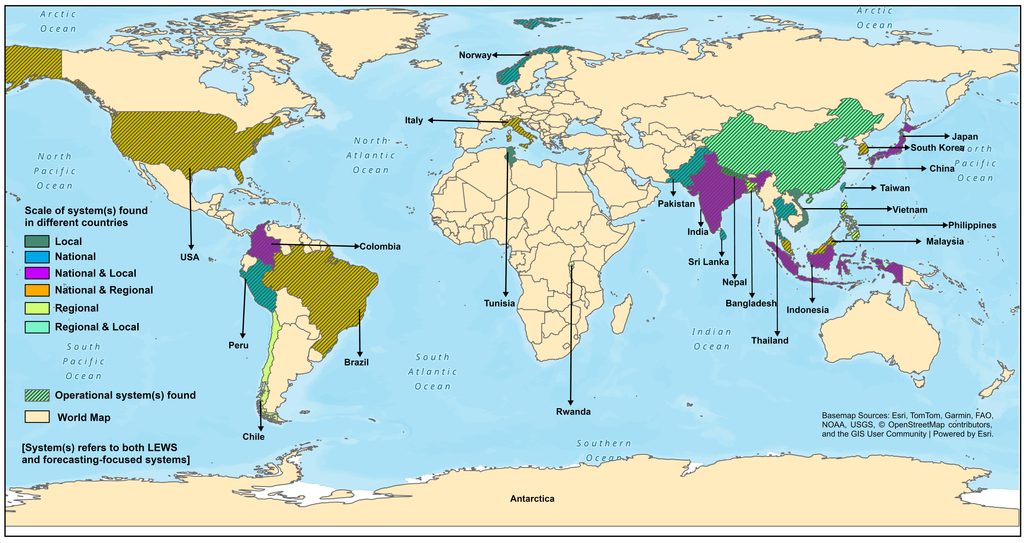
The authors drew on the academic literature, official government and agency sources, and the LandAware catalogue. They identified 45 systems (both forecasting-focused systems and LEWS) in 23 countries, of which 27 were operational, serving 19 countries. National-scale LEWS were largely operational, while forecasting-focused systems were rarely operational, and systems incorporating susceptibility mapping showed a higher proportion of operational status.
Forecasting is not an early warning system. Forecasting is one pillar of an early warning system, not the whole system. The review found that several forecasting-focused systems had been described as early warning systems. Unless a study covers all four pillars, it should be called a forecasting system or model, and the terminology should be corrected accordingly.
Pillars 3 and 4 make the difference. A LEWS is effective only when Pillars 3 and 4 work properly and are well connected to Pillars 1 and 2. A good forecast saves lives and properties only if it becomes an authorised, understandable warning that reaches people and leads to action.
Stronger institutional mechanisms are needed. Whether a system was operational depended more on institutional factors than on any single technology: clear responsibility, routine maintenance, the authority to issue warnings, and established communication channels. Clear mandates and better coordination between agencies are essential. Context matters. Effectiveness also depends on local conditions such as land use, lithology and climate, and on data availability, funding, maintenance capacity and inclusive last-mile communication. So a single global approach cannot replace local calibration and adaptation.
EW4All is transformative, but achieving effective LEWS everywhere by 2027 will be hard without localised approaches, sustained funding, community engagement, and enhanced institutional capacity.
This review might be useful to LandAware community, especially to those developing and operating LEWS.