Categorie
News from members

AGU25 LandAware get-together in New Orleans: Tue, December 16 – 6:30 pm

NEWS received from
Tobias Halter (WSL, Switzerland), Lisa Luna (USGS, USA)

We invite all LandAware Members who will be attending the AGU25 annual meeting, as well as their friends and interested research fellows, to join us for an informal dinner on Tuesday, December 16th.

We will meet after the session Landslide Life Cycle: From Hazard Analysis to Risk Assessment II Oral” and walk from the conference center in about 5 mins to the

We will meet after the session Landslide Life Cycle: From Hazard Analysis to Risk Assessment II Oral” and walk from the conference center in about 5 mins to the restaurant Zesty Creole (https://zestycreole.com/) where we suggest to meet at 6:30 pm (Google Maps: https://maps.app.goo.gl/duTFijbp5MenGWmVA).

If you are interested, please fill in the following google form: https://docs.google.com/forms/d/e/1FAIpQLSd40Ci3kk4FAPo4g3yQyE5ISssDEIuJBRKVONrk34ELRZE9jQ/viewform?usp=dialog

Note, that we have only have space for 25 people, so sign up now to reserve your spot.

We look forward to seeing you in New Orleans.

Categorie
News from members

Newly published paper, “Weather-Induced Landslide Activity in Clayey Slopes: Modeling for the Design of Site-Scale Early Warning Systems”

NEWS received from
Vito Tagarelli (Polytechnic University of Bari, Italy)

A new paper entitled “Weather-Induced Landslide Activity in Clayey Slopes: Modeling for the Design of Site-Scale Early Warning Systems”, has just appeared in the ASCE Journal of Geotechnical and Geoenvironmental Engineering.

The paper explores how soil–vegetation–atmosphere (SVA) interactions control landslide activity in clayey slopes. Drawing on long-term field monitoring and advanced numerical modelling, we show how SVA processes influence pore-water pressures and slope stability, driving both shallow and deep landslides.

This work enabled us to identify effective indicators and precursors—such as pore-pressure patterns and cumulative rainfall thresholds—which may support their integration into landslide early warning systems (LEWS).

The results suggest that a new paradigm for designing LEWS is possible, emphasising the importance of phenomenological and numerical diagnosis of site-specific landslide processes. The framework we propose is applicable to a range of geo-hydro-mechanical contexts as well as future climate scenarios.

The work may be of interest to the LandAware community, given the relevance of the topic to both research and practice.

Categorie
News from members WG07 Operational LEWS

New article collection “Earth and Environmental Sciences: Operational Landslide Early Warning Systems–from Research to Best Practices”

News from:
Davide Tiranti (Regional Agency for Environmental Protection of Piemonte, Italy)

I am pleased to announce, along with my co-editors Graziella Devoli and Minu Treesa Abraham, the launch of a new collection on the Discover Applied Sciences journal (Springer Nature) entitled “Earth and Environmental Sciences: Operational Landslide Early Warning Systems–from Research to Best Practices”.

https://link.springer.com/collections/cbhaibfece

We welcome contributions from anyone involved in defining, designing, and managing Landslide Early Warning Systems, at any scale: from local to global.

We look forward to seeing you!

This collection focuses on the primarily pre-operational, operational and practical aspects related to the design and management of a Landslide Early Warning System and Service (LEWS-S), at local, regional/national, and global scales. We aim to collect contributions not only from the research community engaged on this topic, but also from practitioners responsible for the organisational tasks that must be addressed in daily operations to run an effective and efficient landslide early warning system, to communicate warnings effectively, and to manage the ensuing liability (including legal) implications. Contributions addressing the definition and implementation of early warning systems/services (from research to the development of operational tools), as well as studies on the validation of such systems—particularly in the context of a changing environment driven by global warming—are also welcome.

Categorie
News from members

Landslide Life Cycle Session at AGU2025

News received from
Tobias Halter (WSL, Switzerland)

This year’s AGU annual meeting will take place in New Orleans on the 15 to 19 December 2025. Among many interesting sessions on landslides, don’t miss “NH028 – Landslide Life Cycle: From Hazard Analysis to Risk Assessment” organized by Lisa Luna, Ben Leshchinsky, Stratis Karantanellis, Eric Bilderback and Tobias Halter. The session welcomes contributions across the full spectrum of the landslide life cycle.

Abstract submissions are due by 30 July 2025!

Categorie
News from members

Special session on Landslide processes, hazard, and risk at MedGU25

News received from
Tolga Görüm (Istanbul Technical University, Türkiye)

The 5th Annual Meeting of the Mediterranean Geosciences Union (MedGU25) will be held on 10–13 November 2025 in Athens, Greece, hosted by the National and Kapodistrian University of Athens.

Among several engaging sessions, a Special session on Landslides (Landslides: Processes, Hazard, and Risk) is organized by Tolga Görüm, Ugur Öztürk, Stefano Luigi Gariano, and George Papathanassiou. Among these broad themes, we want to particularly emphasize landslide prediction and early warning.

Hence, we invite you to submit an abstract to this MedGU25 special session.

The abstract submission deadline (1 page / max. 350 words) using this Template is August 25, 2025.

Info: https://2025.medgu.org/

Categorie
LandAware network WG05 Innovations

WG5 meeting with a webinar related to Deep Seated Landslides in North America

NEWS received from
Manfred Stähli, WSL, Switzerland

On Thursday, June 5, 4:00 – 5:00 pm CEST, within the next WG5 meeting, Corey Froese from Wavelength Advisory Services, Edmonton, CA, will present his work on “Advancing Operational Awareness and Warning for Accelerations in Deep Seated Landslides in North America”.

Corey Froese is a geological engineering consultant based in Western Canada and has spent over 30 years focusing on risk management associated with deep-seated landslides. For over 20 years, this has focused on the use of remote-sensed technologies, such as InSAR and Lidar, to characterise spatial and temporal patterns of landslide movement. Over the past four years, Corey has led teams at BGC Engineering to develop relationships between historic landslide displacements and hydroclimatic drivers and displacement trends. Corey’s presentation will provide an overview of the critical learnings from these projects.

Teaser: Slowly moving landslides create unique challenges to infrastructure and communities when displacement rates change over time, typically associated with changes in water balance of different time periods.  The primary challenge for warning is to understand the time periods of moisture infiltration that precede accelerations in order to provide sufficient warning to infrastructure owners to take appropriate actions.  These actions may include proactive mitigation in the periods of years prior to expected accelerations or following exceedance of moisture-related thresholds.   Corey will share learnings from studies across three large regions in North America where different data sets are being utilized to reconstruct historical displacement patterns and integrate these data with hydroclimatic models to better understand hydroclimatic drivers of activity changes.   This presentation will also offer insight into both the temporal and spatial aspects of warning and awareness that end-users are determining are useful to support their operational decisions.

Categorie
News from members

LARAM School 2025: Doctoral school on “Landslide Risk Assessment and Mitigation”

LARAM is an International School on “LAndslide Risk Assessment and Mitigation” of the University of Salerno. The School is held annually and is aimed at 40 PhD students and 10 young doctors selected every year from those working in the field of Civil Engineering, Environmental Engineering, Engineering Geology or with a similar Engineering background.

The LARAM School 2025 will be held in Salerno (Italy) from Monday 8 to Friday 19 September in person.

CANDIDATE PARTICIPANTS

The LARAM class will be composed of:

  • 40 selected PhD students
  • Up to 10 young doctors (PhD defended not before 2020)

Participants pay their own travel and accommodation expenses, as well as a registration fee of Euro 300 (PhD students) or 450 (young doctors).

Deadline for PhD applications and young doctor registrations: May 25, 2024

SCHOOL PROGRAMME

The programme of the school will consist of 6-hour daily lectures and tutorials from Monday to Friday (details on the website). On Saturday, September 13, a field trip will be organized.

The programme is structured in the following sessions:

  • S1, Introduction to landslides
  • S2, Landslide risk theory
  • S3, Landslide modelling
  • S4, Landslide risk analysis and zoning
  • S5, Landslide monitoring and mitigation
  • S6, Landslide risk management and risk governance
Categorie
LandAware network

EGU25 LandAware get-together in Vienna: Thursday, 1 May 2025

Just like the last years, we would like to take advantage of the fact that some LandAware members will be in Vienna at #EGU25 in April/May… to get together for one evening, to meet and talk in person.

We chose Thursday, 1 May, 2025, because that’s the day the session on landslides early warning systems (NH3.7 The use of monitoring, modelling, and forecasting in Landslide Early Warning Systems) is scheduled, thus we are assuming that if you will attend EGU25, you will most likely be in Vienna on that evening.

The get-together will be an informal dinner with good Austrian beer, self-funded by the participants (unfortunately LandAware doesn’t have any funding to manage), in a restaurant/brewery: Salm Brau.
We suggest we meet there at 7:30 PM.

If you are in Vienna on that day, and you like the idea, we ask you to FILL THIS FORM as we need to know in advance the number of people participating (a reservation is necessary in that place).

Looking forward to seeing you in Vienna!

Categorie
News from members

UNDRR questionnaire on how landslide data is collected in your country

NEWS received from
Cees van Westen (University of Twente, The Netherlands)

As part of the process to strengthen national capabilities in tracking disaster losses and damages, the United Nations Office for Disaster Risk Reduction (UNDRR) and its partners encourage the development of data standards and methodological frameworks. These frameworks will enable national actors to coherently record hazardous events and their impacts. This, in turn, will improve the understanding of disaster impacts and support multiple data applications, such as early warning, early action, and risk reduction efforts.

In this regard, the Faculty of Geoinformation Science and Earth Observation of the University of Twente (UT-ITC) will take the lead in conducting a study aimed at improving the cataloguing and impact recording of landslides. This study will provide valuable insights for national organizations responsible for collecting information on hazardous events. The aim is to develop an efficient and feasible reporting framework that can be used to characterize and evaluate landslide databases coherently and consistently across countries.

Ultimately, the findings will be published in a peer-reviewed journal, offering recommendations to enhance the processes and methods used in recording landslide events and their impacts.

We seek support from landslide experts from different countries and would like to ask you to contribute by filling out this questionnaire.

Thank you for your assistance!
Cees van Westen, Luigi Lombardo, Hakan Tanyas, Ashok Dahal and David Urueña Ramirez

Categorie
News from members

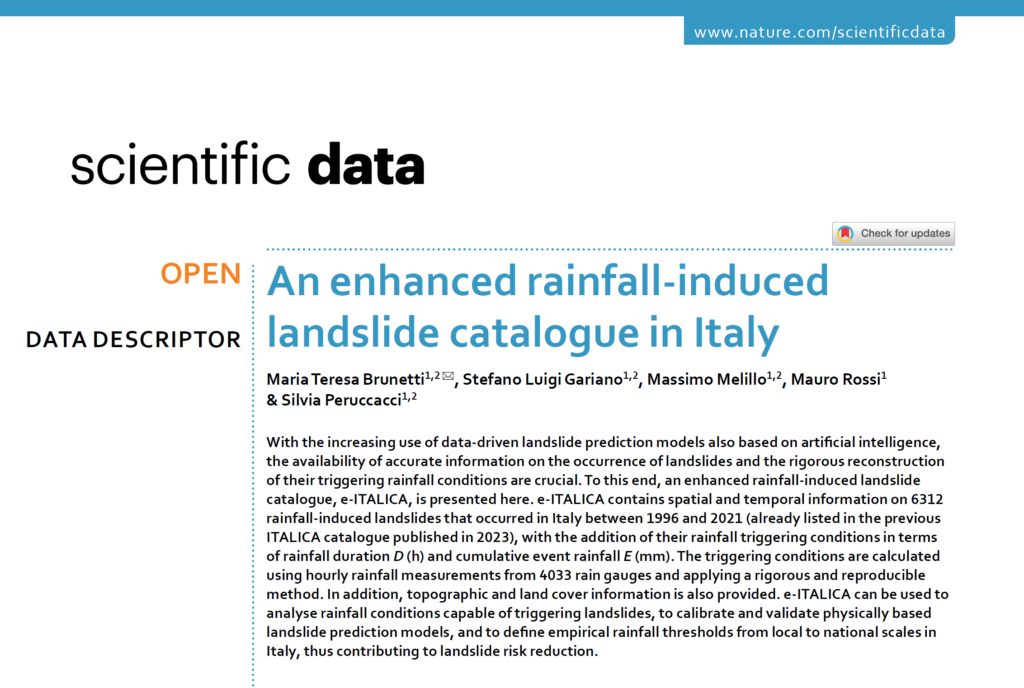
e-ITALICA, an enhanced catalogue of rainfall-induced landslide in Italy

NEWS received from
Maria Teresa Brunetti, Stefano Luigi Gariano, Massimo Melillo, Mauro Rossi, Silvia Peruccacci (CNR, Italy)

The availability of accurate data on landslide occurrence and the rigorous reconstruction of the rainfall conditions that trigger them are essential to improve landslide forecasting, particularly given the growing usage of data-driven landslide prediction models, also based on artificial intelligence.

In this context, we published e-ITALICA, an improved rainfall-induced landslide catalogue, as a result of meticulous data collection and analysis. e-ITALICA includes accurate spatial and temporal information on thousands of rainfall-induced landslides that occurred in Italy between 1996 and 2021 (which were already included in the ITALICA catalogue, previously published in 2023), the triggering rainfall conditions for these landslides, in terms of cumulative event rainfall E (mm) and rainfall duration D (h), and the topographic and land cover information. The triggering conditions were calculated using hourly rainfall measurements from 4000+ rain gauges and applying the CTRL-T software.

e-ITALICA can be accessed and downloaded free of charge from Zenodo: https://doi.org/10.5281/zenodo.14204473

The open-access data descriptor paper is published in Nature Scientific Data: https://doi.org/10.1038/s41597-025-04551-6